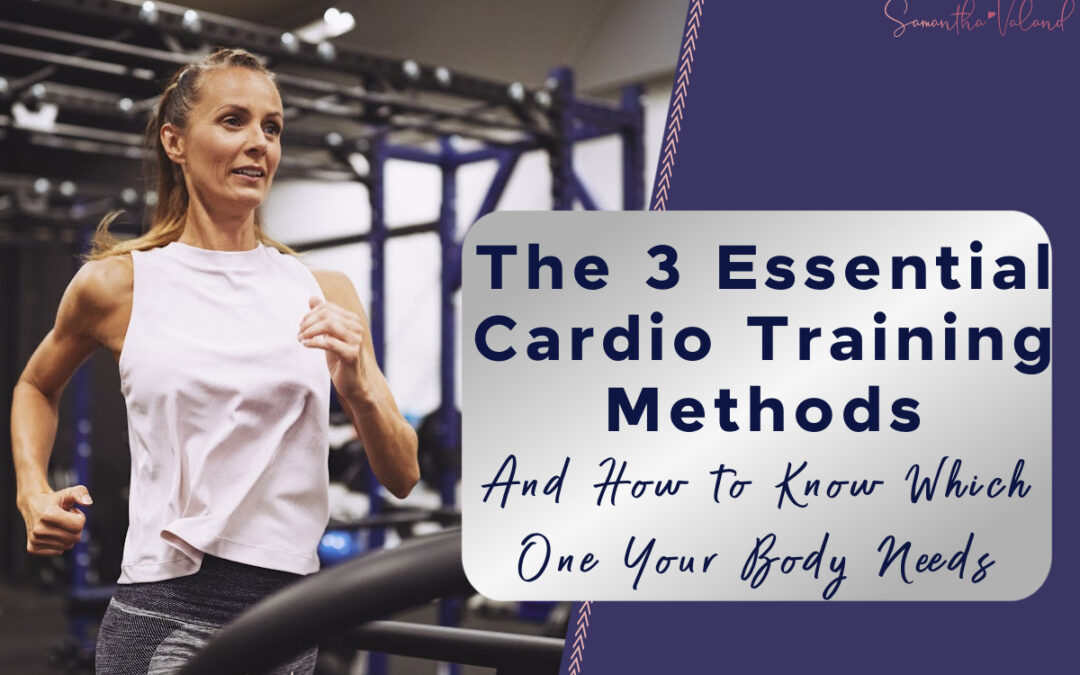
There are three types of cardio training methods. Which gives flexibility to help you work towards your cardio fitness goals when you start to exercise again after the menopause. The three methods are:
- Steady State
- Interval Training
- Fartlek
Steady State Method
Steady state is just as it sounds. It is exercising at the same pace and intensity throughout your session. You may find this comfortable way of training, and any repetitive movements can feel meditative and useful as a stress management tool. It’s also useful for any training when you are aiming to extend the time you are exercising. It’s a brilliant method if returning to classes is one of your goals. Whether you are aiming for a 45- or 60-minutes class. This can be a helpful way of increasing your fitness, so you feel confident starting a class and knowing you can pace yourself to make it through to the end.
Interval Training
As the name suggests, at intervals you change something in your workout. If you are on the treadmill you could change either the incline or speed to increase the intensity. There is a lot of flexibility in this training method. You will find in some gyms, there cardio equipment has programs that will do this for you. If you like a bit more control, then you can manually change the controls yourself. Using blocks of time is the simplest method to start with; You may start with one minute on, one minute rest. Intending to decrease the rest time and therefore increase the intensity. You can use other measurements such as distance if you are on a treadmill or rowing.
It is important to find a baseline line on any piece of equipment you use, your steady state workout settings. When you start to exercise again after the menopause you may find your rest periods need to be more flexible and will sometimes vary from session to session. This will often be a reflection of how you recovered from your previous workout.
Interval training requires concentrating on the time passing, so you know when to adjust your pace. If you are struggling with brain fog after the menopause, you may need a cheat sheet handy with your plan. If it feels like a struggle to keep track then perhaps the Steady State Method may be the best option for now.
Fartlek training
Sounds a bit rude I know. This training method comes from Sweden and translates to “speed play”. It’s less structured than our interval training example above and it is more about using your environment to increase the intensity of your workout. Where I live it’s easy to find stairs to climb or a street with a hill to run or walk up. It’s about changing your perspective on your environment and how you can turn that into bringing increasing activity into daily life.
This can be a great way to bring the mind-body connection into your outdoor workouts. Actively looking for something that will raise or lower your heart rate, whichever you need in the moment. It can be a more engaging way of training that’s feels a bit more fun.
When you start to exercise again after the menopause and are unfit and deconditioned, you may need to do things differently. Familiarising yourself on the three methods and when they work best for you can help you to consistently move.
The way I personalise this is:
- Steady State: I use for low energy and my Deload week. And when I am gently expanding my workout time.
- Interval Training: I use when mentally alert for improving my cardio fitness and variety if I am using a circuit format to workout
- Fartlek: When I’m either meh or bored with my workouts and looking for variety.
How do you personalise your workouts?
Samantha Valand is a Pilates teacher, Yoga Instructor and Personal Trainer turned online Coach. Who helps over fifties women fall in love with exercising again after the menopause. You can find some inspiration over on the blog. Over on my YouTube channel, you can find my Intuitive Exercise Energy Readings. A tool I created to help build intuition and the mind-body connection when you start to exercise again after the menopause. Sign up for my free monthly newsletter to help you live healthy ever after
B A M Workouts
What are B.A.M. Workouts and why would you create a plan for them? They are for the times when your life is complicated and unpredictable (aka your menopause).
Essentials for Starting Mat Pilates in your Fifties
If you are starting mat Pilates in your fifties after the menopause. Here are 3 small equipment essentials to help you tailor your workouts and get the most out of them
Post Menopause Sulky Workouts
If it’s been a struggle to exercise through your menopause and now you can but also meh. Hello Post Menopause Sulky Workouts