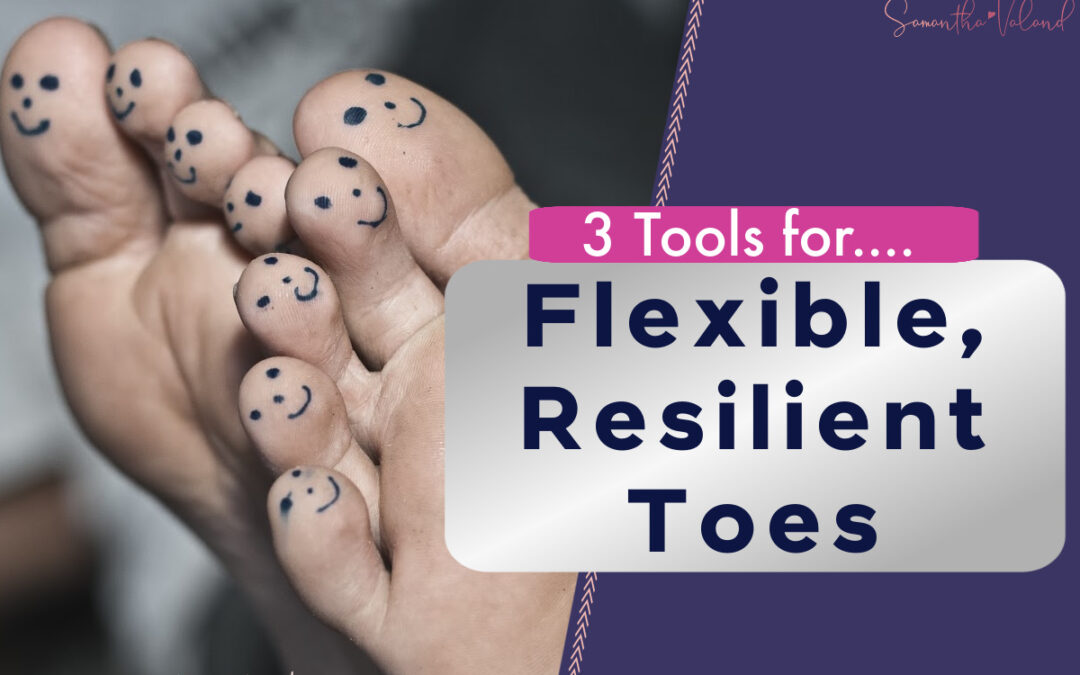
Three Essential Tools for Flexible, Resilient Toes
When you start to exercise again in your fifties, you may find how your toes move has a big impact on your workouts. If you have inflexible feet it can have a significant, negative impact on how you move.
Socks with Toes
Wearing socks with individual slots for your toes, is great visual information. As it’s easy to see how your each toes behave. You may see that some curl really easily while some don’t move much when you expect them too.
It’s great for seeing when you need to manually mobilise your toes if they are not moving the way you expect by themselves.
If you wear socks with toes during the Mexican Wave exercise, it gives a whole new perspective on how each toe joint behaves.
Toe Spreaders
Toe Spreaders sit in between your toes (similar to if you were painting your toenails) which helps to gently separate them. You may already be award of the shape of your toes and if they reflect the shape of the shoes that you have worn over the years.
Hallux Valgus Training Bands
These are probably the smallest resistance bands, that can be looped around your toes.
You can have the band:
- Looped around your big toes for exercises such as calf raises or toe raises
- One end looped around a toe and holding the other end to give resistance against a flexion or adduction movement
When you take a close look at your feet, what do you see? If there is the start of a V between your big toes when your are standing with your feet together. If they are very active at curling (flex) but struggle to lengthen (extend)
It may be time to bring some focus to improving the biomechanics in your feet. And then watch what else improves too!
Samantha Valand is a Pilates teacher, Yoga Instructor and Personal Trainer turned online Coach. Who helps over fifties women fall in love with exercising again after the menopause. You can find some inspiration over on the blog. Over on my YouTube channel, you can find my Intuitive Exercise Energy Readings. A tool I created to help build intuition and the mind-body connection when you start to exercise again after the menopause. Sign up for my free monthly newsletter to help you live healthy ever after
Getting Your Steps in When You Work From Home
Walking changes when the seasons change and getting your steps in when you work from mome, means no incidental walking it’s all deliberate.
Plantar Fasciitis and Menopause
Many women complain of Plantar Fasciitis during the menopause. There isn’t a lot of medical evidence as to why it happens apart from the catch all ‘lowering estrogen levels’ Which is a bit frustrating so let’s look at the non-medical ways as how you can avoid Plantar Fasciitis during menopause and beyond.
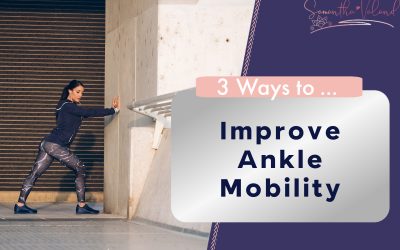
3 Ways to Improve Ankle Mobility
Your ankles and feet are often the most neglected part of the body when it comes to exercising. Here are 3 ways to improve ankle mobility